The Avatars of Vishnu
Source: Wikimedia Commons. Public domain.
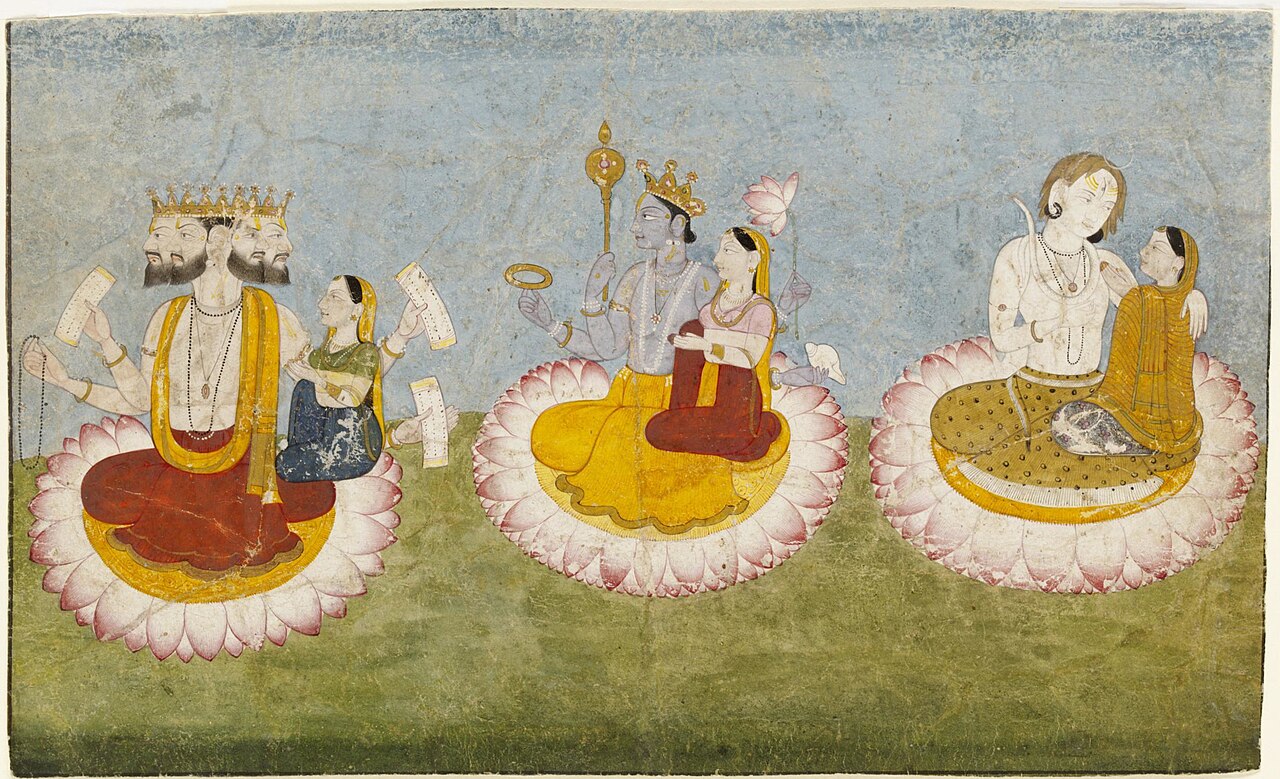
The three most important gods of India are:
-
Vishnu: Protector and restorer.
-
Brahma: Creator.
-
Shiva: Destroyer.
Brahma and Shiva are born from Vishnu, which can be disconcerting since Brahma is the creator of the world. Brahma emerges from Vishnu’s navel and Shiva from his forehead.
Concerning Vishnu (or “he of the long strides,” since he can cross the world in three steps), there exists a great variety of tales, of which the best known are those relating to his various incarnations or avatars, during which he comes to earth in human or animal form with the purpose of helping humanity.
Matsya, the Fish
The first avatar of Vishnu is Matsya, the fish, a form he adopts to protect Manu, the first man, from the flood.
When Manu found the tiny fish, he said: “Take care of me and I will take care of you.” But then the fish grew very large and Manu cast it into the sea. The fish then warned him that a flood was going to occur and told him to build an ark.
When the flood came, the fish grew a horn to which Manu tied the boat, using Ananta, the world serpent, as a rope, and the fish towed it to a safe place.
Kurma, the Tortoise
Kurma, the second avatar, supports Mount Meru and helps the gods recover fourteen treasures from the ocean of milk.
Varaha, the Wild Boar
In his third incarnation, as Varaha, Vishnu saved the world after it had been submerged by the flood and the demon Hiranyaksha had seized it. Varaha killed the demon and raised the earth once more on his tusks.
Narasimha, the Man-Lion
Once there was a demon king named Hiranya-Kashipu who ruled the world. He was cruel, wicked, and invulnerable to men, animals, or gods, inside or outside his house, by day or by night.
One day, as a jest, Hiranya-Kashipu struck a pillar of his palace and asked whether Vishnu was there. To his surprise, Vishnu burst forth roaring in the form of a man-lion, his fourth avatar, and tore the demon apart at dusk in the gallery of the palace.
Vamana, the Dwarf
Vamana, the fifth avatar, was born to curb the power of another demon king: Bali.
When he asked Bali to grant him only as much land as he could cover in three steps, the king laughed and granted the wish. Vamana crossed the entire world, and Bali was left with only the kingdom of Patala, beneath the earth.
Parashu-Rama, the Axeman
In his sixth incarnation, Vishnu was born into the caste of the Brahmins, the priests.
At that time, the warrior caste (Kshatriya) dominated the world, but the gods thought it better that the Brahmins should do so. Thus it was that Parashu-Rama, who was also a warrior, killed Kartavirya, the king of the thousand arms.
Rama, the Gentle
Rama is the seventh avatar of Vishnu. He was born with the mission of slaying the demon Ravana. King Dasharatha prayed for a son, and Vishnu, giving him a cup of divine nectar to be shared among his three wives, made it possible for four sons to be born:
Rama, who received half of the divine essence;
Bharata, who received a quarter;
Lakshmana, who received an eighth; and
Shatrughna, who received the remaining eighth.
In sum, the four brothers share the divine nature of Vishnu.
Krishna, the Lover
Krishna is the eighth avatar of Vishnu, in his role as lover. Krishna’s love for Radha is a recurring theme in Indian literature and art. Nevertheless, Krishna went to war, and it is from his philosophical conversation with Arjuna (the driver of his chariot) that the sacred text of Hinduism would arise: the Bhagavad Gita.
The Buddha, the Historical
The ninth avatar of Vishnu was a historical figure: the Buddha. He taught humanity how to free itself from desire, from the illusions of this world, and from endless reincarnations. The previous reincarnations of the Buddha are recounted in the Jataka Tales.
Kalki, the White Horse
At the end of this age of the world, when humanity has become completely degenerate, Vishnu will come in his tenth incarnation: riding a white horse and raising a sword of fire, he will destroy evil and renew the world.